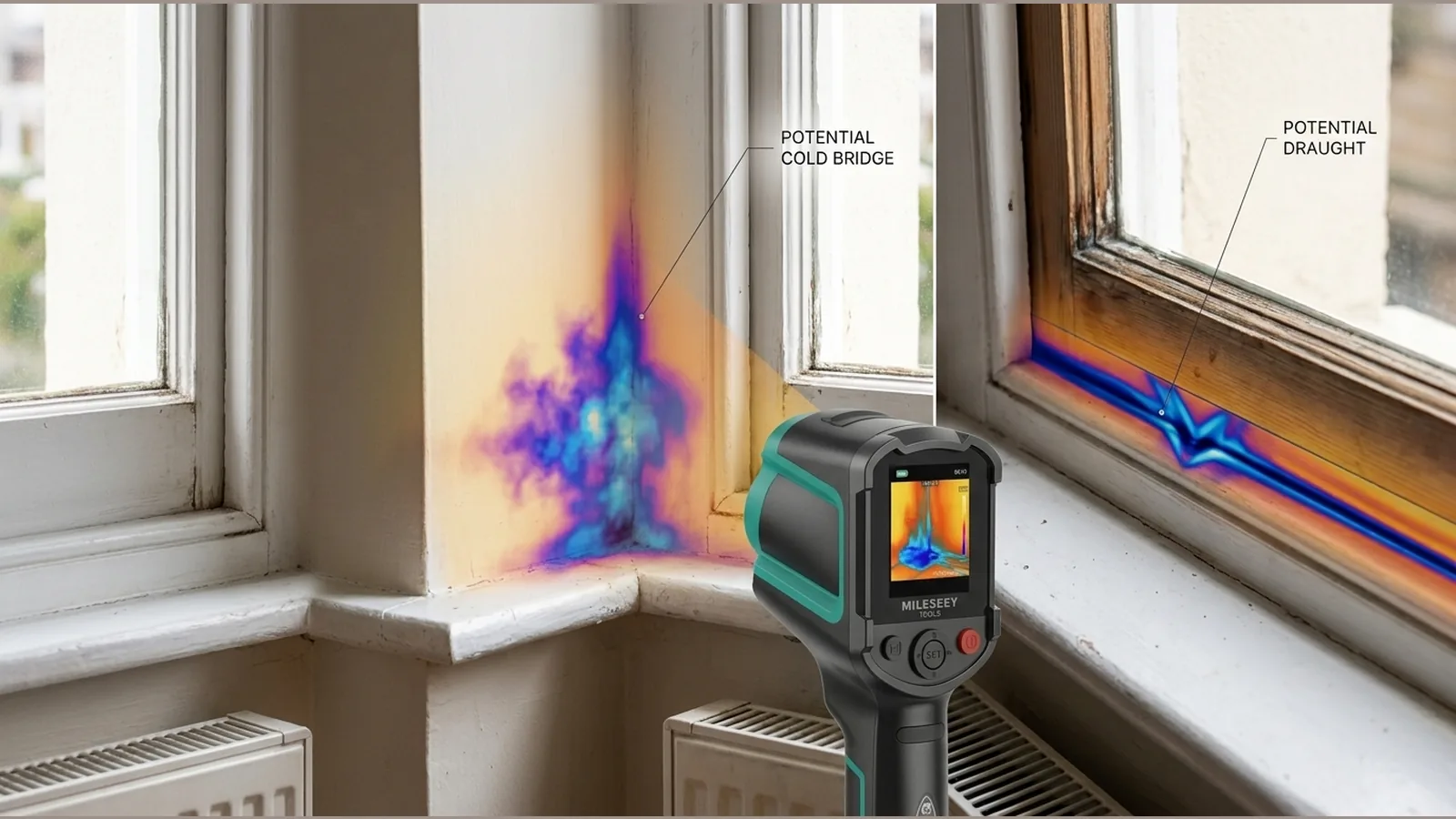
Thermal camera cold bridge vs draught: how to read the pattern carefully
A thermal camera cold bridge vs draught comparison starts with pattern shape and context, not a single cold colour on screen: a cold bridge often shows as a fixed structural chill (for example along a lintel, corner or floor junction), while a draught more often appears as irregular, moving cool streaks near gaps. Thermal imaging is a screening clue only; it does not prove damp, wiring faults, insulation failure or regulatory compliance.
Direct distinction
Treat the image as a map of surface temperature differences. A cold bridge (thermal bridge) is usually tied to the building fabric—a continuous cool band that stays put when doors and windows are closed and air movement is low. A draught is air leakage: cool fingers or patches that shift with wind, extractor fans, open vents or pressure changes.
Public guidance notes that thermal cameras can help reveal draughts, insulation gaps and heating problems, and that colder outdoor conditions generally improve home-survey results. See the East Cambridgeshire thermal camera loan guidance.
Pattern clues and their limits
Useful clues when interpreting a home heat loss scan include:
- Stable cool lines at junctions, slab edges or metal elements may suggest a cold bridge or air leak thermal image worth checking further.
- Cooling that concentrates at seals, letterboxes, loft hatches or the thermal pattern around windows and frames may point toward air leakage.
- Large, patchy cold areas on walls or ceilings can relate to insulation gaps, but the same look can also reflect surface moisture, furnishings or uneven heating.
South Cambridgeshire stresses both a substantial indoor–outdoor temperature difference and training to interpret thermal images—colour alone is easy to misread. Read their advice on thermal imaging cameras. Bracknell Forest likewise notes that imaging can highlight cold spots and insulation gaps, yet findings need appropriate follow-up; see their thermal imaging camera borrowing information.
Weather and heating conditions
Survey quality depends on conditions more than on gadget settings. Aim for a clear indoor–outdoor temperature difference, preferably with outdoor air cooler than the heated interior, as local council guidance suggests. Heat the rooms you plan to scan for a sustained period beforehand, reduce strong sunlight on façades where possible, and avoid scanning immediately after cooking, showering or opening many doors.
Record what was on (heating zones, trickle vents, extract fans) so you can separate fabric-related cold from air-movement effects when you review the images later.
Room-by-room comparison table
Use this table as a prompt for careful reading, not as a diagnosis.
| Area | Cold-bridge-like pattern | Draught-like pattern | What to check next |
|---|---|---|---|
| Windows and doors | Even cool band through the frame or sill junction | Irregular cool streaks at seals, hinges or letter plates | Feel for air movement; inspect seals and closers |
| External walls and corners | Fixed cool corner or floor–wall junction | Cooling that changes with wind or fan use | Compare similar rooms; note furniture shadows |
| Loft hatches and service penetrations | Cool outline of a poorly insulated hatch lid | Cool plume when the hatch is opened or pressure shifts | Confirm hatch fit and any cable or pipe gaps |
| Radiators and pipe runs | Cool wall patches away from heat sources | Cool air paths near unused chimneys or vents | Confirm heating has been on long enough to settle |
Non-thermal checks to confirm
Before assuming a defect, confirm with simple non-thermal checks:
- Hand or smoke-pencil test at suspected gaps on a windy day or with an extractor running.
- Visual inspection of seals, loft insulation continuity and obvious gaps around pipes and cables.
- Compare the same junction on another elevation or in a similar room under the same heating regime.
- Rule out temporary effects: recently opened windows, wet surfaces, or items stored against a wall.
Thermal patterns remain screening clues. Appropriate follow-up—repairs, insulation work or professional assessment—should match what you verify on site, not only what the image suggests.
When to call a specialist
Call a suitably qualified professional when patterns are widespread, when you suspect structural moisture or electrical issues, when retrofit decisions depend on the result, or when you cannot create safe, interpretable survey conditions. Imaging does not replace moisture metering, airtightness testing or a full energy assessment where those are needed.
Next step
If you are shortlisting a handheld infrared thermal imager for careful home screening, review the MILESEEY TR10 handheld infrared thermal imager product details. The TR10 is presented as a handheld unit measuring 224 × 91 × 76 mm, and purchases through this site carry a 12-month warranty term; coverage start date, exclusions and claims process are not detailed here.
FAQ
Can a thermal camera prove I have a cold bridge?
No. It can show a stable cool pattern that is consistent with a cold bridge, but proof needs building context and follow-up checks. Treat the scan as a clue, not a certificate.
Why does the thermal pattern around windows look confusing?
Frames, glass, seals and curtains all cool differently. Irregular cool streaks near seals often suggest air leakage, while a continuous cool band through the junction may relate more to fabric heat loss—always confirm with a physical draught check.
When is the best time to interpret a home heat loss scan?
When there is a substantial temperature difference between indoors and outdoors, heating has been running steadily, and you understand what vents and fans were doing during the scan.
What product facts are confirmed for the TR10 on this site?
Publicly confirmed identity points are limited: it is a MILESEEY TR10 handheld infrared thermal imager, with public-safe dimensions of 224 × 91 × 76 mm and a 12-month warranty term. Unverified performance figures are not published here.